

Table of Contents
- What Advanced Biostructural Correction Is
- How the ABC Technique Works: The Correction Sequence
- What to Expect During a Chiropractic Adjustment with ABC
- ABC Chiropractic Benefits: Alignment, Posture, and Nervous System Freedom
- Advanced Biostructural Correction Evidence: What Research Shows
- ABC vs Activator Method: How They Differ
- Who Is a Good Candidate for Advanced Biostructural Correction
- Risks, Contraindications, and Safety Considerations
- Frequently Asked Questions
Last Updated: October 18, 2026
What Advanced Biostructural Correction Is
Advanced Biostructural Correction, commonly called ABC, is a chiropractic methodology that restores full-body structural alignment through a systematic sequence of low-velocity, high-amplitude adjustments and soft tissue work. Unlike traditional chiropractic, which often treats isolated areas of pain, ABC targets the entire skeletal and soft tissue system to correct underlying mechanical dysfunction.
The core principle behind advanced biostructural correction is that many chronic pain conditions stem from cumulative structural misalignment, particularly in the spine, ribs, and supporting soft tissues.
The technique follows a specific correction sequence designed to work predictably through the body’s structural hierarchy, unlike traditional chiropractic’s focus on symptomatic relief through isolated adjustments. We approach ABC as a full-body structural restoration process rather than a symptom-management tool.
Pro TipThe key distinction: ABC treats structure first, with symptom relief as a secondary outcome. This means your initial appointments focus on assessment and foundational corrections, not immediate pain reduction.
How the ABC Technique Works: The Correction Sequence
Advanced biostructural correction operates through a methodical progression of adjustments and releases that address structural dysfunction from the foundation upward. The technique relies on understanding how misaligned bones, restricted soft tissues, and mechanical tension in the spinal cord and meninges (the membrane surrounding the spinal cord) interact to create pain and dysfunction.
The correction sequence begins with assessment of your entire skeletal structure, not just where you feel pain. An ABC-trained practitioner evaluates spinal alignment, rib positioning, pelvic balance, and overall body mechanics to determine where corrections should begin and in what sequence they should progress.
Initial Assessment and Structural Analysis
Your first ABC appointment involves detailed structural evaluation. The practitioner examines your spine, skeletal alignment, posture, and movement to identify distortions driving your symptoms, many of which may not be where you feel pain.
The practitioner looks for specific misalignments: vertebral subluxations (partial dislocations), rib restrictions, pelvic tilts, and how these affect overall body mechanics, mapping your structural dysfunction so corrections follow a logical, predictable sequence.
This analysis is critical because advanced biostructural correction assumes correcting the primary structural fault will cascade into corrections throughout your system.
Key TakeawayStructural assessment in ABC is comprehensive, practitioners evaluate your entire skeletal system, not just the area causing pain. This prevents treating symptoms while missing the underlying structural driver.
The Role of Meningeal Releases and Soft Tissue Work
Meningeal releases represent a distinctive component of advanced biostructural correction. The meninges are the connective tissue membranes surrounding your spinal cord. When vertebrae misalign or soft tissues become restricted, the meninges can experience mechanical tension, potentially affecting nerve function and spinal cord mobility.
ABC practitioners use gentle, targeted stretching and mobilization to release this meningeal tension and restore the spinal cord’s ability to move freely within its protective covering. This work is often paired with soft tissue techniques addressing muscle restrictions, fascia tightness, and tissue adhesions that limit structural mobility.
The soft tissue component includes targeted stretching, tissue mobilization, and sometimes gentle manipulation of muscles and connective tissue that have adapted to your misalignment.
Bone Alignment and Specific Adjustments
Once soft tissues and meningeal tension are addressed, ABC practitioners perform specific adjustments to restore bone alignment.
Each adjustment targets a precise vertebral misalignment identified during your structural assessment, moving the bone back toward its correct anatomical position to reduce mechanical stress on surrounding nerves, blood vessels, and soft tissues.
Advanced biostructural correction emphasizes that bone alignment must be maintained by addressing the soft tissues and movement patterns that created the misalignment.
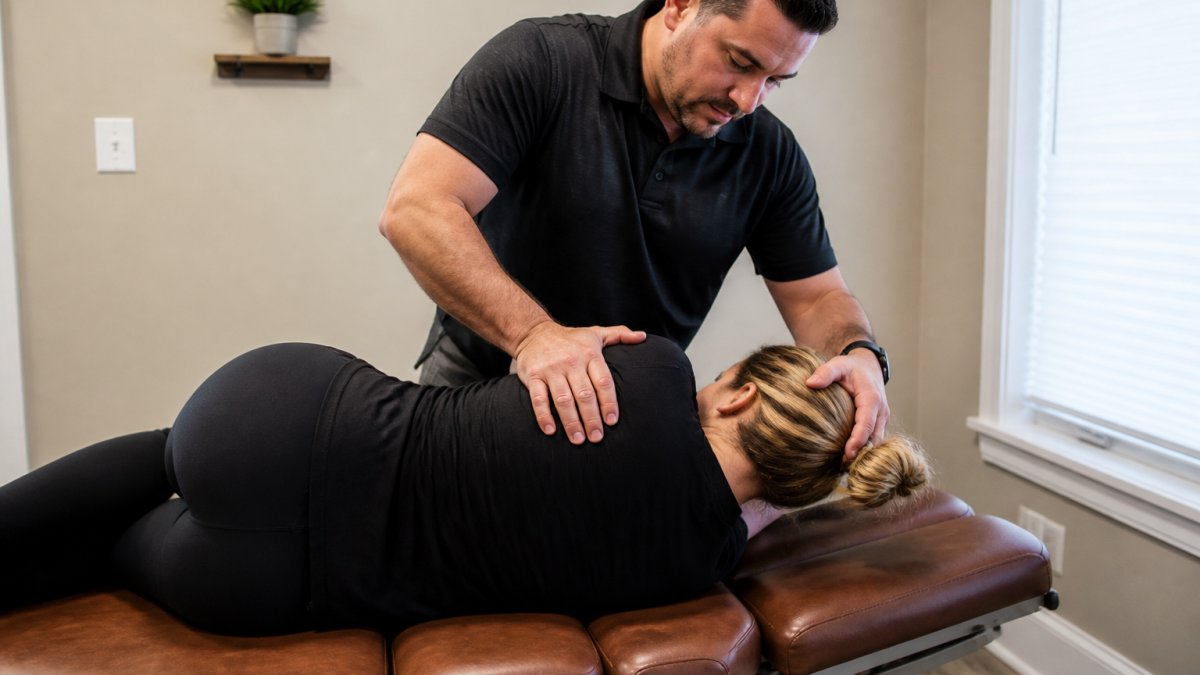
What to Expect During a Chiropractic Adjustment with ABC
An ABC appointment differs substantially from traditional chiropractic visits.
During the adjustment phase, you’ll experience soft tissue work, meningeal release techniques, and specific bone adjustments. Soft tissue work may involve stretching, mobilization, or gentle pressure on restricted areas; meningeal releases often feel like gentle, sustained stretching in your neck or lower back; and bone adjustments are typically low-velocity but involve noticeable movement and positioning changes.
Most patients report ABC adjustments feel more methodical than traditional chiropractic, with less sudden “cracking” and more deliberate repositioning. Sessions typically last 30-60 minutes depending on how much structural work your body requires.
After your adjustment, you may feel immediate relief, mild soreness, or structural “unwinding” as your body adapts. Some patients experience what practitioners call an “unwind”, a temporary increase in sensation or mild discomfort as the nervous system recalibrates, which typically resolves within 24-48 hours.
Watch OutExpect some initial soreness or adjustment reactions, particularly in your first 2-3 sessions. This is normal as your body adapts to corrected alignment. If soreness persists beyond 48 hours or worsens, contact your practitioner immediately.
ABC Chiropractic Benefits: Alignment, Posture, and Nervous System Freedom
Practitioners and patients report that advanced biostructural correction produces benefits beyond pain relief.
Many patients report improved respiratory function after ABC treatment, particularly those with first-rib restrictions or upper-back misalignments. Correcting these distortions improves airway space and makes breathing easier, which often translates to increased energy levels throughout the day.
“Nervous system freedom” is central to ABC philosophy.
Restoration of full mobility represents another commonly reported benefit. As structural alignment improves and soft tissues release, your range of motion typically increases. Activities that felt restricted or painful often become easier and more comfortable.
Advanced Biostructural Correction Evidence: What Research Shows
The evidence base for advanced biostructural correction remains limited compared to traditional chiropractic or conventional medical treatments.
This doesn’t mean ABC is ineffective, it means the research foundation is still developing.
When evaluating ABC, distinguish between the underlying mechanisms (spinal alignment affecting nerve function), which have broader research support, and the specific ABC methodology itself, which has limited independent validation.
Patients considering ABC should ask their practitioner about their clinical outcomes, how they measure patient progress, and what realistic timelines they’ve observed with similar conditions.
The American Chiropractic Association’s clinical guidelines outline evidence standards for chiropractic care and may help you evaluate what constitutes meaningful evidence for any chiropractic approach.
ABC vs Activator Method: How They Differ
The Activator Method and advanced biostructural correction represent two distinct chiropractic approaches, though both emphasize systematic, specific adjustments rather than general manipulation.
The Activator Method uses a handheld mechanical instrument delivering precise, controlled impulses to specific vertebrae, applying consistent force without the variability of manual adjustments.
Advanced biostructural correction, by contrast, emphasizes comprehensive structural assessment and systematic correction of the entire skeletal system, incorporating significant soft tissue work, meningeal releases, and attention to how all body structures interrelate.
The Activator Method works well for patients who prefer instrument-based adjustments or who have conditions where manual manipulation feels uncomfortable. ABC appeals to patients seeking comprehensive structural restoration and those willing to invest more time in the correction process.
Aspect | Activator Method | Advanced Biostructural Correction |
|---|---|---|
Primary Tool | Handheld mechanical instrument | Manual adjustments and soft tissue work |
Session Duration | 15-20 minutes | 30-60 minutes |
Scope | Isolated vertebral corrections | Full-body structural integration |
Soft Tissue Work | Minimal | Extensive |
Meningeal Focus | Not emphasized | Central to methodology |
Best For | Patients preferring instrument-based care | Those seeking comprehensive structural restoration |
Who Is a Good Candidate for Advanced Biostructural Correction
Advanced biostructural correction works best for patients with chronic musculoskeletal issues that have resisted traditional treatment. If conventional chiropractic, physical therapy, or medical treatments haven’t provided sustained relief, ABC may offer a different structural perspective worth exploring.
Ideal candidates typically have structural misalignments contributing to symptoms such as chronic neck pain, lower back pain, postural dysfunction, or movement restrictions. Athletes and active individuals seeking structural optimization for performance often respond well to ABC’s systematic approach.
However, ABC may not be appropriate for everyone.
The best way to determine candidacy is a consultation with a qualified ABC practitioner, who can assess your condition, explain whether ABC addresses your structural issues, and discuss realistic outcomes.
Best ForChronic pain sufferers who’ve tried traditional approaches without lasting relief, athletes seeking structural optimization, office workers with postural dysfunction, individuals with scoliosis or degenerative disc issues seeking non-invasive management.
Risks, Contraindications, and Safety Considerations
Like all chiropractic care, advanced biostructural correction carries risks that deserve honest discussion.
More serious risks, while rare, include nerve irritation, disc herniation, or vascular complications from spinal manipulation.
Pregnancy requires special consideration.
Recent spinal surgery, acute inflammation, or undiagnosed neurological symptoms warrant medical evaluation before ABC treatment.
Informed consent matters. Before beginning ABC, you should understand the proposed treatment plan, realistic outcomes, potential risks, and alternatives; a practitioner who rushes this discussion or guarantees specific outcomes raises legitimate concerns.
The relationship between your primary care physician and your ABC practitioner matters. Ideally, these providers communicate about your care.
The American Medical Association’s guidance on chiropractic care safety provides additional perspective on risk assessment for spinal manipulation.
Advanced biostructural correction represents a systematic approach to structural restoration that differs meaningfully from traditional chiropractic care. If you’ve struggled with chronic pain or structural dysfunction, a consultation with Dr Dom can help determine whether advanced biostructural correction addresses your underlying structural issues. Current clinical standards for chiropractic practice outline what to expect from qualified practitioners.
Frequently Asked Questions
What is Advanced Biostructural Correction and how does it differ from traditional chiropractic?
Advanced Biostructural Correction (ABC) is a structural alignment technique that focuses on correcting bone position, releasing soft tissues, and reducing mechanical tension on the nervous system. Unlike traditional chiropractic, which often addresses isolated joint dysfunction, ABC uses a systematic correction sequence targeting the entire skeletal structure. The approach emphasizes meningeal releases and specific low-velocity adjustments designed to create lasting alignment changes rather than temporary relief.
What should I expect during an Advanced Biostructural Correction session?
Your first session typically includes a detailed structural assessment to identify misalignments and areas of mechanical tension. The practitioner will perform targeted adjustments using specific techniques tailored to your body’s needs. Sessions may involve soft tissue work, meningeal releases, and bone realignment adjustments. Most patients experience the process as hands-on and methodical, with the practitioner explaining each step. Follow-up sessions build on previous corrections as your body gradually restabilizes in proper alignment.
Is there scientific evidence supporting Advanced Biostructural Correction?
ABC is based on principles of structural biomechanics and nervous system function, though independent peer-reviewed research on the ABC method specifically is limited. Some concepts underlying ABC, such as the relationship between spinal alignment and nerve function, align with established chiropractic and orthopedic principles. Practitioners report consistent clinical outcomes, but prospective patients should discuss the current evidence base with their provider and understand that outcomes vary individually. Consulting with a qualified practitioner can help you determine if ABC is appropriate for your condition.
How does ABC differ from the Activator Method?
The Activator Method uses a handheld spring-loaded instrument to deliver rapid, high-amplitude impulses to specific joints, focusing on isolated adjustments. Advanced Biostructural Correction, by contrast, uses hands-on, low-velocity techniques and emphasizes soft tissue work and meningeal releases alongside bone alignment. ABC aims to address the entire structural system and reduce mechanical tension on nerves, while the Activator Method targets individual joint restrictions. The choice between them depends on your condition, preferences, and practitioner expertise.
What are the main benefits of Advanced Biostructural Correction?
Patients often report improved spinal alignment, reduced chronic pain, better posture, enhanced mobility, and improved respiratory function. By freeing the nervous system from mechanical tension, ABC may support better overall body function. Many people experience relief from stubborn pain that didn’t respond to other treatments. Benefits typically develop over multiple sessions as structural corrections stabilize and your body adapts to proper alignment.
Am I a good candidate for Advanced Biostructural Correction if I have degenerative discs or scoliosis?
Many people with degenerative disc disease or scoliosis can benefit from ABC, but candidacy depends on your specific condition and medical history. Structural correction may help reduce mechanical stress on affected areas and improve overall alignment. However, certain conditions require careful assessment before beginning treatment. A consultation with a qualified ABC practitioner will determine whether this approach is appropriate for you and identify any contraindications or necessary precautions.
Why do adjustments from traditional chiropractors sometimes not stick, and how does ABC create longer-lasting results?
Traditional adjustments often address isolated joint dysfunction without correcting underlying structural imbalances. When the broader skeletal system remains misaligned, joints may return to their original position. Advanced Biostructural Correction works systematically to realign the entire structure and release soft tissue restrictions that hold misalignments in place. By addressing root structural causes rather than symptoms alone, ABC aims to create stable, lasting corrections. Results depend on consistency, body mechanics, and individual healing capacity.