
Last Updated: October 30, 2026
Quick Summary
Chiropractic care for construction worker back pain focuses on how the spine moves and aligns, not just where it hurts, with the aim of restoring motion and easing nerve pressure. A plan typically starts with an examination of posture, range of motion, and how your spine moves under load, then may combine spinal adjustments, soft-tissue work, and lifting guidance.
- Twisting while holding a load is the most common way workers strain a disc, so turn with your feet.
- Hold stretches for about 20 to 30 seconds before and after each shift.
- See a chiropractor if symptoms last more than a week despite home care.
- Keep materials between knee and shoulder height and stage deliveries on pallets or stands.
- Report a jobsite injury to your supervisor the same day, even if pain seems minor.
Table of Contents
- Why Construction Worker Back Pain Keeps Coming Back
- Lower Back Pain in Construction Workers: Causes and Risk Factors
- Safe Lifting Techniques for Construction Workers
- Stretches for Construction Workers With Back Pain
- How Chiropractic Care Addresses Work-Related Back Pain
- When to See a Chiropractor for Back Pain
- Jobsite Ergonomics, Workers’ Compensation, and Returning to Work
- Book an Appointment With Dr. Dom
- Frequently Asked Questions
Why Construction Worker Back Pain Keeps Coming Back
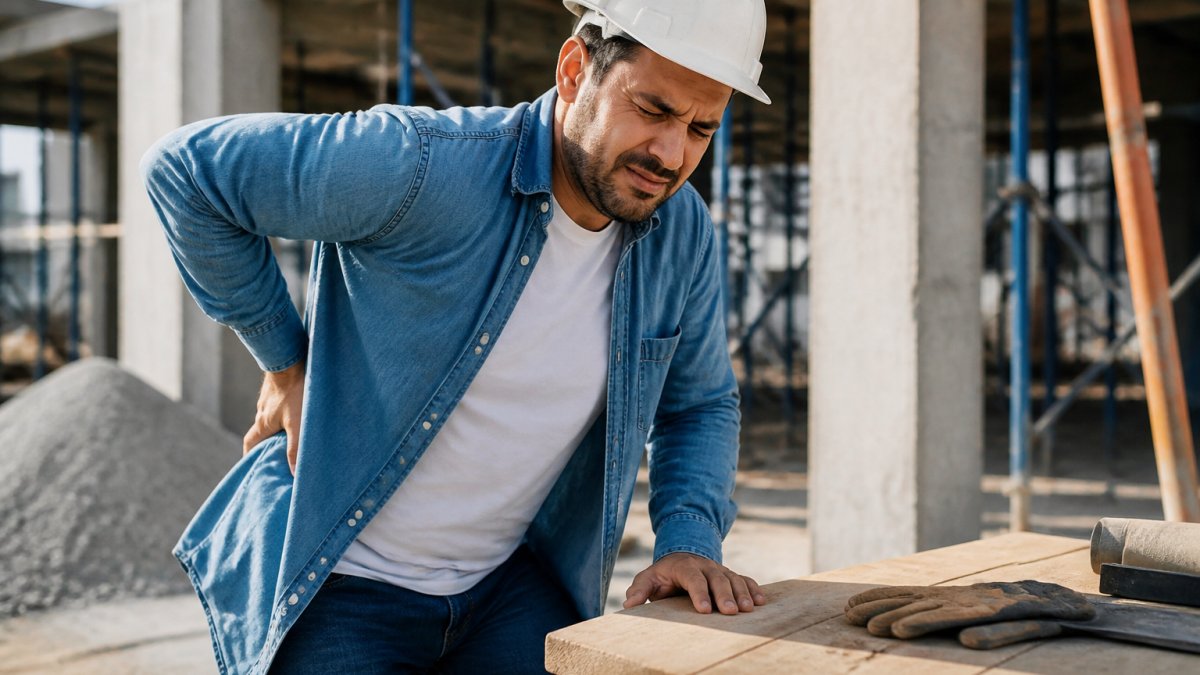
Construction worker back pain rarely has a single cause, and that is exactly why it can keep returning. The pain settles down with rest, then flares the moment the work picks up again. (Source: Occupational Safety and Health Administration)
Here is the part most guides get wrong. They treat the flare-up and stop there. The Occupational Safety and Health Administration has long flagged musculoskeletal disorders as a leading category of workplace injury, and construction sits near the top.
Below, we break down common causes, lifting habits that help protect the spine, and how chiropractic care may fit into a practical recovery plan.
Lower Back Pain in Construction Workers: Causes and Risk Factors
Lower back pain in construction workers is often associated with repetitive strain on the muscles, ligaments, and spinal discs. The work is physical, the loads are heavy, and the postures are often awkward. Over months and years, that adds up.
Three forces drive most of it:
- Repetitive strain from the same motion, thousands of times
- Heavy lifting without a plan or a partner
- Awkward postures like overhead work, kneeling, and twisting
Tasks That Put the Most Load on Your Spine
Some jobsite tasks load the spine harder than others. A common mistake is treating them all the same.
- Carrying bags of concrete or mortar on one shoulder
- Bending to pick up tools and materials from the ground
- Twisting while carrying lumber or pipe
Tasks like these can place sustained load on the spinal discs and the muscles that support the vertebrae, and repeated strain may contribute to stiffness over time.
Symptoms That Signal a Workplace Injury
Not every ache is a workplace injury. Here is what should get your attention:
- Pain that starts during a shift and lingers after
- Stiffness that eases with movement but returns with rest
- Decreased mobility when bending or twisting
If symptoms show up after a specific task, write down the date and what you were doing. A written record can be useful if a workers’ compensation claim becomes necessary; confirm the requirements with your employer and your state’s workers’ compensation agency.
Safe Lifting Techniques for Construction Workers
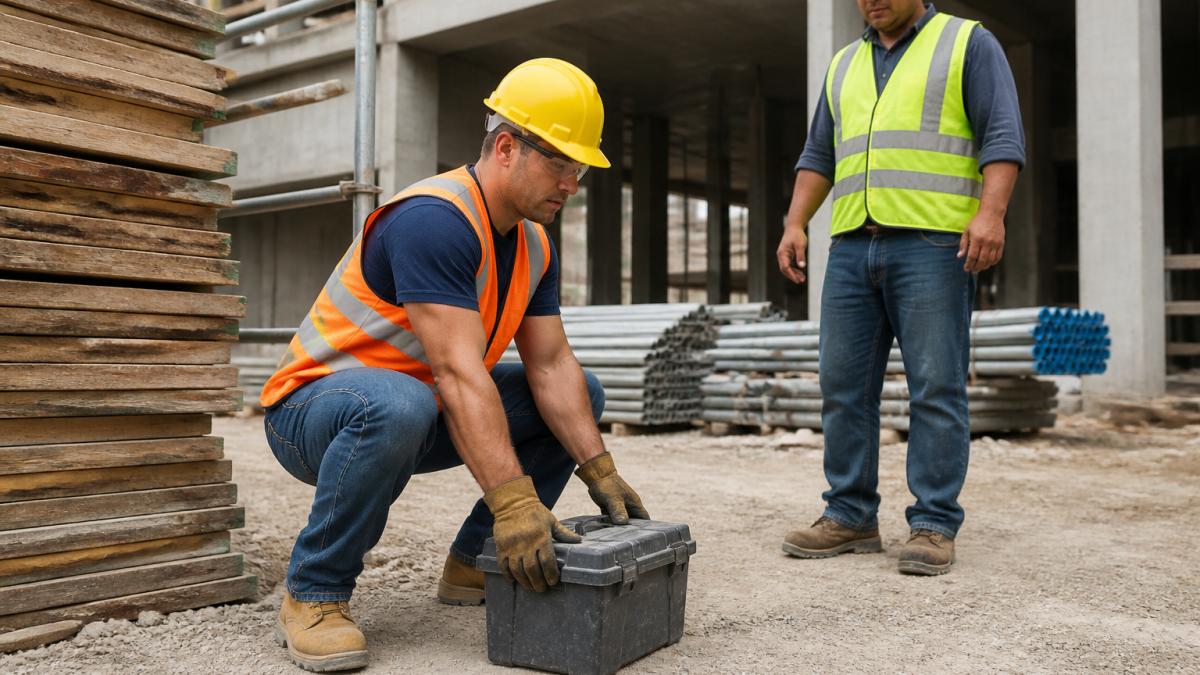
Safe lifting techniques for construction workers come down to one idea: let your legs and your core do the work, not your lower back. The lift you use once matters less than the lift you repeat all day.
A Step-by-Step Lift You Can Repeat All Day
- Size up the load before you touch it. Too heavy? Get help or a cart.
- Set your feet shoulder-width apart, close to the object.
- Squat with your hips back and chest up, keeping your spine neutral.
- Grip firmly and pull the load close to your body.
- Tighten your core, then drive up with your legs.
- Keep the load at waist height. Do not twist to set it down.
- Step, turn with your feet, then lower with your legs.
Watch out: twisting while holding a load is the single most common way workers strain a disc. Turn with your feet, not your spine.
Stretches for Construction Workers With Back Pain
Stretches for construction workers with back pain should ease stiffness without forcing the spine. A short routine before the shift and again at the end goes a long way.
Try these, holding each for about 20 to 30 seconds:
- Knee-to-chest: lie on your back, pull one knee gently toward your chest
- Cat-cow: on hands and knees, alternate arching and rounding your spine
- Hip flexor stretch: half-kneel, tuck your pelvis, lean forward slightly
Stop any stretch that sends pain down a leg. Stretching should ease stiffness, not create it.
How Chiropractic Care Addresses Work-Related Back Pain
Chiropractic care for work-related back pain generally focuses on how the spine moves and aligns, not just where it hurts.
A treatment plan generally starts with an examination of posture, range of motion, and how the spine moves under load.
If your lower back is the main problem, you can read more about chiropractic lower back care and what it involves.
Spinal Adjustments, Alignment, and What Advanced Biostructural Correction Does Differently
Spinal adjustments are generally intended to restore motion in joints with restricted movement. Some patients report that standard adjustments provide only short-term relief.
Advanced Biostructural Correction™ (ABC) is the technique this practice specializes in, and it focuses on full-body alignment. For a full breakdown, see our guide on how Advanced Biostructural Correction works.
When to See a Chiropractor for Back Pain
When to see a chiropractor for back pain depends on how long symptoms last, how they behave across the workday, and whether they interfere with safe lifting. As a general guideline, persistent pain or pain that interferes with safe lifting is worth having evaluated by a qualified professional.
See a chiropractor sooner if:
- Pain returns every time you return to full duty
- Stiffness limits your range of motion when bending, twisting, or reaching overhead
- Symptoms have lasted more than a week despite home care (Source: National Institute of Neurological Disorders and Stroke)
A common mistake is waiting until the pain is severe. Early evaluation can help clarify your condition and create a documented record if a workers’ compensation claim becomes necessary.
Red Flags That Need Urgent Medical Care
Some symptoms need a doctor right away, not a chiropractor. Get urgent care or call emergency services if you have:
- Loss of bladder or bowel control
- Numbness in the groin or saddle area
- Sudden weakness in one or both legs
These signs can point to conditions that should be evaluated by a physician before any chiropractic care is considered. If you have a known disc injury, read our guide on whether structural correction is safe for herniated discs before starting care.
Watch Out
If you have any red-flag symptom, stop and seek medical evaluation first. Do not book a chiropractic adjustment until a physician has cleared you.
If you have any red-flag symptom, stop and seek medical evaluation first. Do not book a chiropractic adjustment until a physician has cleared you.
What to Bring to Your First Visit
A first chiropractic visit for work-related back pain goes faster and produces a better plan when you bring specifics:
- The date and task when symptoms started, or the date you first noticed them
- Which tasks make the pain worse and which make it better
- Any prior back injuries or episodes
That history helps the chiropractor decide whether care is appropriate, what to adjust, and when to refer you back to a physician.
These are the signs that mean it is time to have your back pain evaluated rather than waiting it out.
| Sign | What it looks like |
|---|---|
| Pain returns with full duty | Pain comes back every time you return to full duty |
| Limited range of motion | Stiffness limits bending, twisting, or reaching overhead |
| Home care stops helping | Rest and stretching no longer help |
| Modified movement | You change how you lift or walk to avoid pain |
| Symptoms persist | Symptoms last more than a week despite home care |
Jobsite Ergonomics, Workers’ Compensation, and Returning to Work
Jobsite ergonomics and a clear return-to-work plan are what keep construction worker back pain from coming back. Adjust the work to the body where you can, and document what happened when you cannot.
Jobsite Ergonomics That Actually Fit Construction Work
General back-safety advice rarely survives a real jobsite. These adjustments translate it into construction tasks:
- Material handling: Keep materials between knee and shoulder height. Stage deliveries on pallets or stands rather than the ground so you are not bending to pick up every board or bag.
- Load handling: Use carts, hoists, and team lifts for heavy loads. A two-person lift is not a sign of weakness, it is a way to keep both workers on the job.
- Tool use: Use longer-handled tools for floor-level work and adjustable stands for overhead drilling to reduce time spent bent or reaching.
Workers’ Compensation: Report, Document, Coordinate
If you are injured on the job, report it to your employer promptly and document the task, date, and symptoms. Workers’ compensation rules vary by state, so confirm the process with your employer and your state’s workers’ compensation agency.
A practical documentation sequence:
- Report the injury to your supervisor the same day, even if the pain seems minor.
- Write down the task, the date, the load or posture involved, and when symptoms started.
- Keep a symptom log, what makes it worse, what makes it better, and how it affects your ability to work.
- Save copies of the injury report, any medical notes, and correspondence about your claim.
- Ask before you switch providers, some claims require care to be coordinated through a designated provider or network.
For repetitive strain that builds over time rather than a single incident, our article on chiropractic care for repetitive strain injury goes deeper on how those claims are typically handled.
Pro Tip
Report early even when you plan to work through it. A same-day report is easier to support than one filed weeks later, and it protects your options if the pain worsens.
Report early even when you plan to work through it. A same-day report is easier to support than one filed weeks later, and it protects your options if the pain worsens.
Returning to Work Without Re-Injuring Your Back
Returning to work should be gradual. Build back your range of motion and strength before you jump to full duty. A common pattern is a staged return:
- Light duty first: paperwork, spotting, or tasks that avoid heavy lifting and repeated bending.
- Partial duty next: add lifting within a comfortable range, with a partner for heavier loads.
- Full duty last: return to unrestricted lifting, overhead work, and repetitive bending only when you can do them without modifying your movement.
Criteria for moving to the next stage usually include pain that stays stable or improves with activity, full range of motion, and the ability to lift and carry without guarding or compensating. If pain flares with each stage, that is a signal to slow down rather than push through.
Coordinate the return-to-work plan with your employer and your treating provider so the restrictions on paper match what the jobsite actually requires.
Book an Appointment With Dr. Dom
Construction worker back pain does not have to be the thing you just live with.
At Dr Dom, Dr. Dominick Fazzari brings over 35 years in private practice and expertise in Advanced Biostructural Correction™. We offer individualized care, home and office visits, and no long-term contracts.
Get started with Dr Dom and get back to full work capacity. Book an appointment with Dr. Dom today.
Frequently Asked Questions
Can chiropractic care help construction workers with back pain?
Chiropractic care is one option some construction workers consider for managing work-related back pain, with aims that can include spinal alignment, nerve pressure, and range of motion. A treatment plan typically combines spinal adjustments with guidance on posture, lifting mechanics, and stretching. Results vary by injury type and severity, so a full assessment matters before starting care. If you have red flags like numbness, weakness, or loss of bladder control, seek urgent medical evaluation first.
What causes lower back pain in construction workers?
Lower back pain in construction workers usually comes from repeated bending, twisting, and heavy lifting that strain the spinal discs, muscles, and ligaments. Carrying materials, working overhead, and standing on hard surfaces for long shifts add cumulative load. Over time this repetitive strain can cause inflammation, stiffness, and decreased mobility. Early intervention and better jobsite ergonomics reduce the chance of a long-term problem.
When should a construction worker see a chiropractor for back pain?
See a chiropractor for back pain when soreness lasts more than a few days, keeps returning after shifts, or starts limiting your work capacity. Book a consultation if you notice stiffness, reduced range of motion, or pain that radiates into the leg. Bring any imaging or workers’ compensation paperwork so your treatment plan accounts for your full history.
What stretches may help relieve back pain after construction work?
Stretches for construction workers with back pain often include knee-to-chest stretches, hip flexor stretches, cat-cow, and gentle hamstring stretches. Hold each for about 20 to 30 seconds without bouncing, and stop if pain sharpens or travels down the leg. Stretch after your shift when muscles are warm, and pair stretching with strength work for the core and glutes. Consistent daily movement supports long-term mobility better than occasional stretching.
