• 274 Madison Ave, Suite 1304 New York, NY 10016
  • 2 Leefield Gate, Melville, NY 11417

Two Locations

In New York

Top-Rated

NYC Chiropractor

Thousands Of

Satisfied Patients
For Consultation: (212) 682 4311

Author Archives: admin

Chiropractor for Neck Pain in Manhattan: What to Expect

Last Updated: October 23, 2026

Quick Summary

A chiropractor for neck pain in Manhattan focuses on the mechanical side of the problem: how the joints of the neck move, how surrounding muscles respond, and what restores normal function. Care starts with a thorough history, physical and neurological exam, and a plain-language explanation of findings before any treatment. At Dr Dom, there are no long-term contracts, and care is reviewed as you progress.

  • Desk work is a major driver of neck pain, with eight hours hunched over a laptop a predictable pattern.
  • A chiropractic adjustment is a controlled, precise movement applied to a spinal joint to restore motion and reduce pain.
  • The most useful habit is a movement break every 30 to 45 minutes, such as two minutes of chin tucks and shoulder rolls.
  • Seek urgent medical care for neck pain after significant trauma or with severe headache, fever, confusion, or new weakness.
  • Ask about the new-patient exam fee, per-visit treatment fee, imaging costs, and insurance participation before you book.

Table of Contents

Why Neck Pain Sends So Many Manhattan Office Workers Searching for a Chiropractor

Neck pain is one of the most common reasons adults book a chiropractic visit, and desk work is a major driver. At Dr Dom, we see a steady stream of office professionals whose neck stiffness started as a minor annoyance and turned into a daily problem. (Source: a 2023 report by the U.S. Bureau of Labor Statistics)

The pattern is predictable. Eight hours hunched over a laptop, a monitor set too low, a phone cradled between ear and shoulder during calls. Muscles tighten, joints stiffen, and range of motion drops.

A chiropractor for neck pain in Manhattan focuses on the mechanical side of that problem: how the joints of the neck move, how the surrounding muscles respond, and what can be done to restore normal function.

Below, we explain what causes neck pain, what an adjustment involves, how long recovery tends to take, and the questions worth asking before you book.

Common Causes of Neck Pain and Stiffness

Most neck pain falls into a handful of categories, and identifying yours shapes the treatment plan.

  • Postural strain. Sustained forward head position loads the neck muscles and joints for hours at a time.
  • Muscle tension. Stress and poor sleep tighten the upper back and neck, limiting movement.
  • Joint dysfunction. Stiff spinal joints in the neck and upper back reduce mobility and refer pain into the shoulders.
  • Disc injuries. Discs in the cervical spine can bulge or degenerate, sometimes producing arm symptoms.

Many patients arrive with a mix of these. A proper evaluation separates them before any treatment begins.

What a Chiropractic Adjustment for Neck Pain Actually Involves

A chiropractic adjustment for neck pain is a controlled, precise movement applied to a spinal joint to restore motion and reduce pain. The goal is not to “crack” the neck for its own sake.

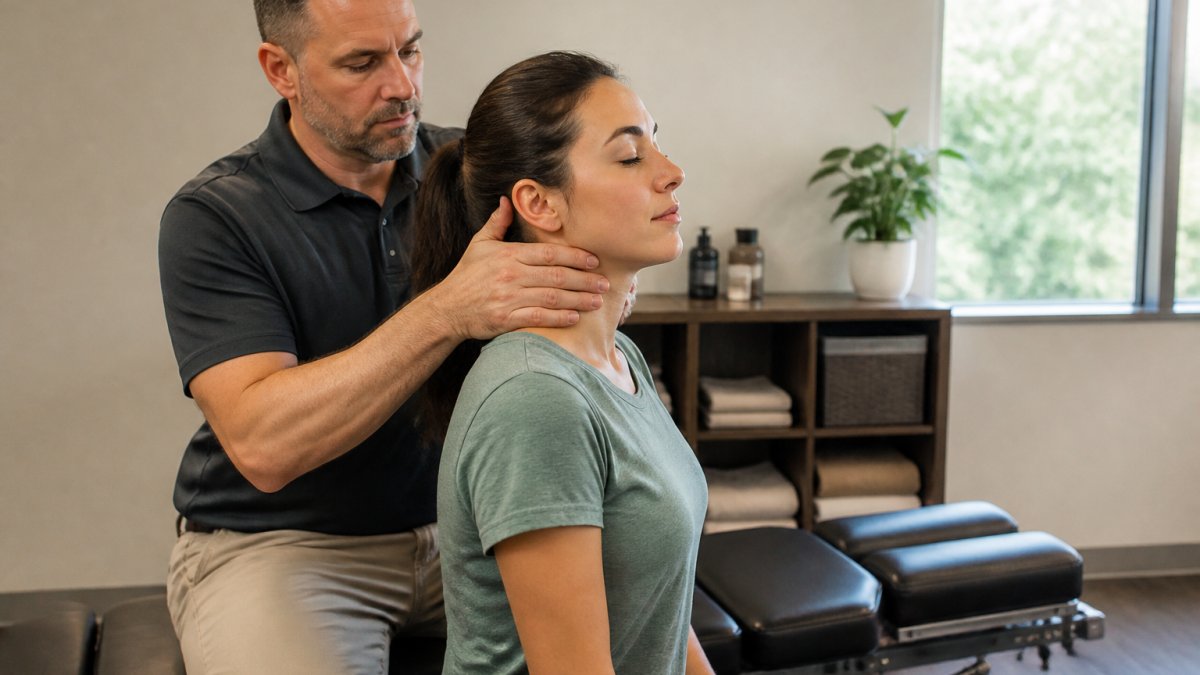
A licensed chiropractor gently guiding a seated adult patient through a neck mobility assessment in a bright, clean treatment room with natural light

Spinal Manipulation and Other Techniques

Spinal manipulation is the best-known technique: a quick, controlled thrust that moves a joint slightly beyond its restricted range. Patients often hear a pop, which is gas releasing within the joint, not bone moving.

Other approaches include:

  • Mobilization. Slower, gentler joint movement for patients who prefer a lighter touch.
  • Soft tissue work. Hands-on treatment of tight muscles and fascia.
  • Traction. Gentle stretching of the cervical spine.
  • Home exercise. Prescribed movement to hold the gains between visits.

How Advanced Biostructural Correction Differs

Conventional adjustments often treat the painful segment in isolation. Advanced Biostructural Correction™ (ABC) works from a different premise: the body compensates around old injuries, and those compensations pull posture out of line.

ABC focuses on identifying and correcting those underlying structural shifts, working through the body in a specific sequence. Patients who have had adjustments that “feel good for a day and then the pain returns” often find this approach addresses why the problem kept coming back.

How Long Does Neck Pain Last, and How Many Visits Will You Need?

How long neck pain lasts depends on its cause. Pain with arm numbness, weakness, or after trauma needs prompt medical assessment.

Visit frequency varies by patient. A common approach is more frequent visits early on, tapering as mobility improves. We do not use long-term contracts at Dr Dom; care is reviewed as you progress, and you decide how long to continue.

Neck Pain Exercises and At-Home Habits That Support Recovery

Neck pain exercises work best when they match your specific restriction, not when copied from a generic list.

BOOK AN APPOINTMENT →

  • Chin tucks. Gently draw the chin straight back, hold briefly, repeat. This counters forward head posture.
  • Cervical rotation. Turn the head slowly side to side within a comfortable range.
  • Shoulder blade squeezes. Draw the shoulder blades together to wake up the upper back.
  • Desk setup. Raise the monitor to eye level and keep the phone off your shoulder.
Pro Tip
The most useful habit is a movement break every 30 to 45 minutes. Two minutes of chin tucks and shoulder rolls does more for neck stiffness than one long stretch at the end of the day.

Chiropractor Consultation Questions to Ask Before You Book

Most clinic pages tell you to “book a consultation” without explaining what will actually happen in the room. That ambiguity is why so many first-time patients arrive unsure whether they are getting an exam, a sales pitch, or an adjustment. A careful chiropractor will walk you through the process before you commit, and the questions below help you confirm that.

What a First Appointment Should Include

A thorough first visit for neck pain generally follows a predictable sequence. Ask whether the practice follows it.

  1. History-taking. Expect questions about when the pain started, what makes it better or worse, prior injuries, imaging you have already had, medications, and any neurological symptoms such as numbness, tingling, or weakness in the arms or hands. A rushed history is a red flag.
  2. Physical and neurological examination. This typically includes range-of-motion testing, palpation of the neck and upper back, orthopedic tests, and a basic neurological screen (strength, sensation, reflexes). If the practitioner skips the neurological screen, ask why.
  3. Explanation of findings and consent. Before any treatment, you should hear a plain-language explanation of what the examiner found, what technique is proposed, what the alternatives are, and what the risks are. You should be asked for consent, not assumed to have given it.
  4. Treatment, if appropriate. Some practitioners treat on the first visit; others prefer a second visit after reviewing findings. Either is reasonable, but you should know which to expect before you book.
  5. Home instructions. You should leave with specific guidance on movement, activity modification, and what symptoms would warrant a call back or urgent care.

Questions Worth Asking Before You Book

  • What does your evaluation include, and will you explain your findings in plain language?
  • Do you perform a neurological screen, and will you tell me if my case needs imaging or a medical referral?
  • Which technique do you plan to use, and why is it right for my case?
  • Will you treat on the first visit, or is treatment scheduled after the exam?
Pro Tip
Ask the front desk two practical questions when you call: how long the first appointment lasts and whether the exam and any treatment are billed separately. The answers tell you a lot about how the practice operates.

A practitioner who welcomes these questions, and answers them without pressure, is usually the one worth seeing.

When Neck Pain Needs Urgent Medical Evaluation

Some neck pain is not a chiropractic case, at least not yet. Seek urgent medical care for neck pain after a significant trauma, or if it comes with severe headache, fever, confusion, loss of coordination, or new weakness or numbness in the arms or hands. Persistent discomfort that does not require emergency intervention often responds well to a structured approach toward fixing chronic neck stiffness.

Watch Out
Do not book a routine adjustment for neck pain that follows a fall, a car accident, or that arrives with neurological symptoms. Get medically cleared first. Treating an undiagnosed injury can delay proper care.

For most mechanical neck pain, chiropractic care is a reasonable conservative option. For anything with red flags, medical evaluation comes first.

Finding the Right Neck Pain Chiropractor in Manhattan

Choosing a chiropractor for neck pain in Manhattan comes down to three things: a thorough evaluation, a technique suited to your problem, and a plan you understand, including what it will cost and how often you will need to come in.

Costs, Insurance, and Visit Expectations

Chiropractic pricing varies widely by practice. Ask for these specifics when you call:

  • New-patient exam fee. This is usually separate from treatment and often includes history, examination, and a report of findings.
  • Per-visit treatment fee. Confirm whether it changes based on technique or visit length.
  • Imaging costs. X-rays or other imaging, if needed, may be billed separately or referred out.
  • Insurance participation. Ask which plans the practice is in-network with, whether verification is done before your visit, and what your estimated out-of-pocket responsibility will be. If the practice is out-of-network, ask for a superbill you can submit for reimbursement.

At Dr Dom, there are no long-term contracts; care is reviewed as you progress, and you decide how long to continue. The practice offers home and office visits for patients who cannot easily travel to a clinic.

What to Look For in a Practitioner

  • A clear exam before treatment. The practitioner should explain findings and get your consent before any adjustment.
  • A technique that fits your case. Gentle mobilization may suit some patients; others may be candidates for spinal manipulation or a structural approach such as Advanced Biostructural Correction™.
  • A plan you understand. You should know the expected number of visits, how progress will be measured, and what would prompt a referral to another provider.
  • Willingness to coordinate. A good practitioner will refer for imaging or to a physician when red flags are present.

Dr. Dominick Fazzari brings more than 25 years of clinical experience and over 35 years in private practice, with a focus on Advanced Biostructural Correction™ and individualized care.

If your neck pain has resisted previous treatment, book an appointment and get a proper structural assessment. Relief starts with understanding what is actually driving the problem, and what the care will involve.

Frequently Asked Questions

Can a chiropractor really fix neck pain?

Chiropractic care can reduce neck pain and improve mobility for many people, particularly when the pain comes from muscle tension, joint restriction, or posture-related strain. A neck pain chiropractor typically combines spinal manipulation with posture guidance and home exercises. Results vary by cause and severity, and some conditions, such as fractures or infections, are not appropriate for adjustment. A proper evaluation first determines whether care is suitable for you.

How long does neck pain usually last?

Many episodes of uncomplicated neck pain ease within one to two weeks, though stiffness can linger for several weeks. Pain linked to disc injuries, degenerative changes, or long-standing postural strain often takes longer and benefits from a structured care plan. If pain persists beyond a few weeks, worsens, or comes with numbness or weakness, get evaluated rather than waiting it out.

Is chiropractic treatment safe for neck pain?

Spinal manipulation for the neck is generally considered low risk when performed by a licensed chiropractor after a proper evaluation. Mild soreness for a day or two is the most common side effect. Serious complications are rare but possible, so tell your provider about prior neck surgery, disc herniation, osteoporosis, or blood-thinning medication. Anyone with red-flag symptoms such as severe headache, fever, or neurological changes should seek medical care first.

What should I ask during a chiropractor consultation?

Ask what technique the chiropractor uses for neck pain, how many visits they expect and how progress is measured, what the first appointment includes, and whether they coordinate with your physician. Also ask about costs, insurance, and what to do if pain worsens between visits. A provider who answers these clearly and adjusts the plan to your condition is a good sign.


Neck pain that keeps returning is a signal that the underlying cause was never addressed. Dr Dom offers individualized chiropractic care built around Advanced Biostructural Correction™, with home and office visits, no long-term contracts, and a plan tailored to your body. Book an appointment with Dr. Dominick Fazzari and start with a clear assessment of what is causing your pain.


Chiropractic Care for Repetitive Strain Injury

Table of Contents

Last Updated: October 21, 2026

What Is Repetitive Strain Injury and Why It Matters

Repetitive strain injury, often called RSI or repetitive stress disorder, develops when you perform the same motion repeatedly over time, fatiguing and irritating your muscles, tendons, and nerves. Unlike an acute injury from a single incident, RSI builds gradually as damage accumulates with each repetition until pain and dysfunction emerge.

Office professionals, construction workers, athletes, and healthcare staff face the highest risk. Anyone whose work demands repetitive tasks, typing, gripping, lifting, or reaching, can develop RSI. The condition affects your wrists, shoulders, neck, elbows, and lower back depending on which movements dominate your routine.

At Dr Dom, we’ve assessed thousands of satisfied patients whose repetitive strain injuries stemmed from poor posture, inadequate ergonomics, or movement patterns that placed excessive load on specific joints. The problem isn’t always the activity itself but how your body performs it. When your spine lacks proper alignment, your joints move inefficiently and muscles compensate by working harder, creating pain, weakness, and reduced mobility over weeks and months.

The good news: repetitive strain injury responds well to targeted intervention. Many assume RSI is permanent or requires surgery, but addressing underlying movement patterns and structural alignment often reverses symptoms, and early intervention prevents progression to more serious conditions.

Key Takeaway
Repetitive strain injury develops from accumulated stress on muscles and joints during repetitive tasks. The underlying cause is usually poor posture, misalignment, or inefficient movement patterns, not the activity itself.

Work-related repetitive motion injury announces itself through specific warning signs.

Weakness accompanies pain. Your grip strength declines, lifting becomes difficult, and you drop things you previously handled easily.

Numbness and tingling are red flags. These sensations indicate nerve involvement. You might feel pins and needles in your fingers, hand, or forearm. Some patients report numbness that wakes them at night. This suggests significant nerve compression requiring prompt attention.

Reduced range of motion develops as muscles tighten and inflammation builds. Turning your head becomes stiff. Reaching overhead grows uncomfortable. Your shoulder, wrist, or elbow feels locked in certain positions.

Swelling and inflammation may appear: your wrist, hand, or shoulder visibly puffs and feels warm to the touch. Inflammation is your body’s response to repeated microtrauma, and while protective initially, chronic inflammation perpetuates pain and dysfunction.

The mistake most people make: they ignore early warning signs. A minor ache seems manageable, so you work through it, and the underlying damage accelerates. Early assessment matters: identifying repetitive strain injury before it becomes severe prevents long-term complications.

Watch Out
Numbness, tingling, or weakness that radiates down your arm or hand may indicate nerve compression. If these symptoms persist beyond a few days or worsen despite rest, seek professional evaluation promptly. Delayed treatment of nerve compression can cause permanent damage.

How Chiropractic Care Addresses Repetitive Strain Injury at Its Source

Chiropractic care for repetitive strain injury focuses on restoring proper alignment and movement efficiency. Rather than treating pain as an isolated symptom, we identify why the injury developed in the first place.

The conventional approach often relies on pain management, ice, anti-inflammatory medication, rest. These provide temporary relief but don’t address the structural or movement issues driving the problem. Pain returns when you resume activity because the underlying cause remains unresolved.

Chiropractic care for repetitive strain injury works differently. We assess your posture, spinal alignment, and movement patterns, examining how your joints move and identifying restrictions, compensations, and imbalances. This comprehensive evaluation reveals the root cause, usually a combination of postural distortion, joint misalignment, and inefficient movement patterns.

Advanced Biostructural Correction™ (ABC), the specialized technique Dr Dom uses, targets the specific structural distortions contributing to your repetitive strain injury. Rather than generic adjustments, ABC identifies your unique structural patterns and corrects them systematically, producing lasting results because it addresses why your body developed the problem.

Spinal Alignment and Nerve Irritation

When vertebrae misalign, they compress or irritate nerves, which send pain signals and reduce the strength of muscles they supply, causing radiating pain, numbness, or weakness. Restoring proper spinal alignment removes this compression, so nerves recover function and pain diminishes as strength returns.

Spinal misalignment also disrupts communication between your brain and the muscles performing repetitive tasks. Your nervous system cannot coordinate movement efficiently, so muscles work against each other instead of in harmony, creating the muscle tension and fatigue characteristic of repetitive strain injury.

Chiropractic adjustment realigns vertebrae, restoring normal nerve function. As alignment improves, your nervous system regains the ability to coordinate movement precisely. Muscles work more efficiently. Fatigue decreases. Pain resolves because the underlying nerve irritation has been eliminated.

The alignment of your cervical spine (neck) particularly influences repetitive strain in your upper extremities. Forward head posture, common in office workers, stretches nerves and muscles in your neck and shoulders. This creates a cascade of compensation patterns down your arms. Correcting cervical alignment stops this cascade at its source.

Soft-Tissue Therapy and Muscle Tension Relief

Muscles surrounding misaligned joints become chronically tight, contracting to stabilize the unstable joint. This tension creates pain, restricts motion, and accelerates fatigue during repetitive tasks, and soft-tissue therapy releases it.

Techniques like massage, myofascial release, and trigger-point therapy address muscle tightness directly. These therapies improve blood flow to affected tissues. Increased circulation delivers oxygen and nutrients, accelerating healing. Tension dissipates. Range of motion improves. Pain decreases.

Soft-tissue therapy combined with chiropractic adjustment produces superior results compared to either approach alone. Adjustments restore alignment. Soft-tissue work releases the muscular compensation patterns that developed around the misalignment. Together, they create an environment where your body can heal completely.

Many patients with repetitive strain injury have developed scar tissue within muscles and fascia from months or years of tension and microtrauma. Soft-tissue therapy breaks down scar tissue, restoring normal tissue elasticity. This prevents the repetitive strain injury from recurring when you return to your normal activities. Maintaining this newfound suppleness requires consistent ergonomic adjustments and targeted tension relief solutions that you can integrate into your daily workspace routine.

Pro Tip
Soft-tissue therapy is most effective when combined with postural correction and ergonomic changes. Releasing muscle tension without addressing the underlying movement patterns often provides only temporary relief.
::: (Source: National Institute of Neurological Disorders and Stroke (NINDS) information on nerve compression)

Ergonomic Workspace Setup Tips to Prevent Recurrence

Ergonomic modifications are essential to prevent your repetitive strain injury from returning. Even perfect chiropractic care cannot overcome a workspace that forces poor posture and inefficient movement.

Professional sitting at an ergonomic desk with ideal posture to support chiropractic care for repetitive strain injury

Your monitor should sit at eye level, approximately 20-26 inches from your eyes. The top of the screen aligns with your eyes when you look straight ahead.

BOOK AN APPOINTMENT →

Your keyboard and mouse should be positioned so your elbows bend at approximately 90 degrees. Your wrists remain neutral, not bent upward, downward, or to the sides.

Your chair must support the natural curve of your spine, and lumbar support is critical. Without it, your lower back rounds forward, compressing discs and irritating nerves.

Take frequent breaks. Stand and move every 30-45 minutes. Prolonged static posture, even perfect posture, creates problems.

Ergonomic ElementCorrect PositionCommon Mistake
Monitor heightTop of screen at eye level, 20-26 inches awayToo low, forcing forward head posture
Keyboard/mouseElbows at 90 degrees, wrists neutralWrists bent or elevated, causing nerve compression
Chair supportLumbar curve supported, hips slightly above kneesNo lumbar support, lower back rounded
Break frequencyMovement every 30-45 minutesSitting continuously for hours
LightingNatural or diffuse artificial light, no glareBright overhead lights causing neck strain

Lighting matters more than most people realize. Poor lighting forces you to crane your neck or lean forward to see clearly. This creates postural strain.

If your job requires frequent phone use, use a headset rather than cradling the phone between your ear and shoulder. Shoulder cradle creates severe neck and shoulder strain.

What to Expect: Chiropractic Adjustment Recovery Time and Progress

Recovery from repetitive strain injury varies based on severity and how long the condition has been present.

Your first appointment involves a thorough assessment. We evaluate your posture, spinal alignment, movement patterns, and joint function, identify restrictions and compensations, and perform orthopedic and neurological tests to assess nerve function.

Initial treatment sessions may produce soreness similar to mild muscle soreness after exercise. This is normal as your muscles adapt to improved alignment and movement patterns, typically resolving within 24-48 hours. Ice can help manage any discomfort.

Most patients notice initial improvement within 1-2 weeks: pain decreases, range of motion improves, and strength begins returning. However, early improvement doesn’t mean the underlying problem has been fully corrected, so consistent care for the full treatment duration ensures lasting results.

Progress plateaus are common. You might improve significantly for 2-3 weeks, then notice no additional improvement for a week. This doesn’t indicate treatment failure. Plateaus reflect your body’s adaptation process. Continuing care breaks through plateaus.

Home exercises and stretches accelerate recovery. We provide specific exercises targeting your particular restrictions. Performing these daily reinforces the corrections we make during appointments and prevents regression between sessions.

When to Seek Medical Evaluation Beyond Chiropractic Care

Certain symptoms warrant evaluation by a physician or specialist before or alongside chiropractic care. Knowing when to seek additional evaluation protects you from complications.

Severe pain that doesn’t improve with rest suggests a more serious underlying condition. Fractures, significant nerve compression, or disc herniation require imaging and possibly medical intervention.

Rapidly progressive weakness indicates significant nerve compression. If your grip strength deteriorates over days or your hand becomes noticeably weaker, seek immediate medical evaluation. Progressive neurological deficit can indicate a serious condition requiring urgent attention.

Numbness that spreads or involves multiple areas of your body suggests systemic involvement.

Symptoms that don’t improve after 4-6 weeks of appropriate care warrant reassessment. We may recommend imaging to identify structural issues we cannot detect through physical examination.

History of significant trauma, car accident, fall, or major injury, complicates assessment. Even if the trauma occurred years ago, residual structural damage can predispose you to repetitive strain injury. Medical imaging helps identify any underlying structural issues.

Red-flag symptoms requiring immediate medical attention include sudden severe pain, loss of bowel or bladder control, severe neurological changes, or unexplained fever. These suggest serious conditions requiring emergency evaluation.

If you experience sudden loss of bowel or bladder control, severe progressive weakness, or unexplained fever alongside your repetitive strain injury symptoms, seek immediate medical evaluation. These may indicate serious conditions requiring urgent intervention.


Repetitive strain injury develops from accumulated stress on structures performing repetitive tasks. With over 25 years of experience helping patients eliminate stubborn pain and restore mobility, Dr Dom provides the individualized assessment and targeted treatment that produces lasting results. BOOK AN APPOINTMENT with Dr Dom and discover how structural correction can resolve your repetitive strain injury.

Frequently Asked Questions

How is Advanced Biostructural Correction different from traditional chiropractic care for repetitive strain injury?

Advanced Biostructural Correction™ (ABC) focuses on full-body structural alignment rather than isolated adjustments. While traditional chiropractic care may provide temporary relief through spinal manipulation, ABC addresses underlying postural imbalances and movement patterns that contribute to repetitive strain injury. This comprehensive approach targets the root causes of nerve irritation and muscle tension, leading to more lasting results and reduced recurrence of symptoms.

Can chiropractic care fully resolve repetitive strain injury, or is it just temporary relief?

Chiropractic care can provide significant relief and help restore function for many people with repetitive strain injury, especially when combined with ergonomic changes and activity modification. However, outcomes depend on the severity of the condition, how long symptoms have persisted, and your commitment to preventing recurrence. A chiropractor can assess your specific situation during a consultation and discuss realistic expectations for your recovery.

What are red-flag symptoms that mean I should see a doctor instead of a chiropractor for my repetitive strain injury?

Seek medical evaluation if you experience sudden severe pain, numbness or tingling that doesn’t improve, loss of grip strength, signs of infection, or symptoms that worsen despite treatment. If you have a history of herniated discs, spinal fractures, or other serious conditions, consult your physician before starting chiropractic care. A qualified chiropractor will also recommend medical referral if findings suggest a condition outside their scope of practice.

How many chiropractic sessions does it typically take to feel relief from repetitive strain injury symptoms?

Recovery timelines vary widely based on the severity of your condition, how long you’ve had symptoms, and how well you follow ergonomic and activity modifications. Some people notice improvement within a few sessions, while others require several weeks of consistent care. Your chiropractor will develop a personalized care plan with progress measures and adjust treatment as needed. Pricing and session frequency depend on your individual needs, contact Dr Dom for a consultation to discuss your specific situation.

Fix Body Alignment for Better Energy: A How-To Guide

Table of Contents

Last Updated: October 19, 2026

Why Body Alignment Affects Your Energy Levels

Your posture shapes how your body functions. When your spine is misaligned, your muscles work harder to keep you upright. This extra effort drains your energy throughout the day.

Body alignment affects more than just comfort. It influences how your lungs expand, how oxygen reaches your cells, and how efficiently your nervous system operates. Poor alignment compresses your chest and restricts breathing. Restricted breathing means less oxygen.

The connection between spinal alignment and energy is direct and measurable.

Pro Tip
Your posture is not a cosmetic issue, it’s a physiological one. The position of your spine determines how much work your muscles must do just to keep you standing or sitting. Fix that position, and your body stops wasting energy on compensation.

When your vertebrae stack properly, your muscles relax. Your diaphragm expands fully. Your heart pumps more efficiently. Energy that was spent fighting misalignment becomes available for movement, thinking, and recovery.

Signs of Poor Posture You Should Know

Poor posture develops gradually. Most people don’t notice it until pain arrives. By then, muscle imbalances are already established.

Watch for these warning signs:

  • Rounded shoulders that roll forward when you’re not thinking about it
  • Forward head position where your ears sit ahead of your shoulders
  • Excessive upper back rounding (kyphosis) that creates a curved spine
  • Lower back arching too much (hyperlordosis) with a protruding belly
  • Feet that turn outward instead of pointing straight ahead
  • Uneven weight distribution when standing, favoring one leg
  • Neck tension and headaches that worsen as the day goes on
  • Shoulder blade pain or tightness between your shoulder blades

These signs indicate your body is working against itself. Muscles on one side shorten while others lengthen and weaken. This imbalance creates tension, restricts movement, and depletes energy.

Watch Out
Ignoring these signs leads to chronic tension and accelerated wear on your discs and joints. What starts as poor posture becomes structural damage if left uncorrected.

Poor posture also affects your mood and mental state. When your chest is compressed and your shoulders rounded, your nervous system interprets this as a defensive or stressed position. Your body responds by increasing cortisol and reducing energy production.

How Breathing and Diaphragm Function Support Alignment

Your diaphragm is a large muscle beneath your lungs. It’s responsible for 70% of your breathing work.

Slouching compresses your abdomen and restricts diaphragm movement.

Proper spinal alignment opens your ribcage. Your diaphragm can contract fully. Air fills your lungs completely.

The mechanics are simple: upright posture expands your chest cavity. An expanded chest cavity allows full diaphragm expansion.

When you fix body alignment for better energy, one of the first changes people notice is easier breathing.

American Lung Association guidance on breathing mechanics

Key Takeaway
Breathing efficiency depends on spinal alignment. You cannot achieve deep, full breathing with a collapsed posture. Fix your alignment, and your lungs work better automatically.

Desk Posture Tips for Office Professionals

Office work creates specific alignment problems. Sitting for eight hours compresses your spine and weakens your core. Your hip flexors tighten. Your chest muscles shorten. Your back muscles lengthen and weaken.

Use these desk posture tips to counteract these effects:

  1. Position your monitor at eye level so your head stays neutral, not tilted down
  2. Keep your elbows at 90 degrees with your keyboard at wrist height
  3. Place your feet flat on the floor with your knees at 90 degrees
  4. Sit with your hips and knees level, not tilted forward or back
  5. Keep your shoulders relaxed away from your ears
  6. Use a chair with lumbar support that maintains your lower back curve
  7. Take a standing break every 30 minutes to reset your alignment
  8. Avoid crossing your legs, which rotates your pelvis and misaligns your spine

The goal is neutral spine positioning. Your ears should align with your shoulders. Your shoulders should align with your hips. Your hips should align with your knees.

Most office setups encourage poor alignment. Monitors sit too low. Chairs lack support. Desks are too high or too low.

OSHA ergonomic standards for office workstations

Pro Tip
The best posture is your next posture. Even perfect alignment becomes problematic if you hold it without moving. Stand up, stretch, and reset your position every 30 minutes.

Posture Exercises for Beginners: A Progressive Routine

Fixing body alignment requires consistent practice. These exercises activate the muscles that support proper posture. Start with Step 1 and progress only after you can perform each exercise comfortably for two weeks.

Step 1: Assess Your Current Alignment

Before exercising, understand where you are starting.

Stand sideways in front of a mirror. Take a photo from the side. Look at the line from your ear to your shoulder to your hip to your ankle.

Write down what you notice. This is your baseline. Return to this photo every two weeks to track progress.

Proper standing alignment means:

  • Ears directly above shoulders
  • Shoulders directly above hips
  • Hips directly above knees
  • Knees directly above ankles
  • Feet pointing straight ahead

Most people discover their head is forward, their upper back is rounded, or their lower back arches too much. This assessment tells you which muscles need the most attention.

Step 2: Activate Your Core and Mid-Back

Your core stabilizes your spine. Your mid-back muscles pull your shoulders back and open your chest. These two muscle groups are critical for maintaining alignment.

Wall Angel Exercise (perform 2 sets of 10 reps, 3 times per week):

  1. Stand with your back against a wall
  2. Bend your elbows to 90 degrees with your upper arms at shoulder height
  3. Slowly slide your hands up the wall, keeping your elbows and back in contact with the wall
  4. Slide your hands back down to the starting position
  5. Move slowly and stop if your lower back arches away from the wall

Dead Bug Exercise (perform 2 sets of 8 reps per side, 3 times per week):

BOOK AN APPOINTMENT →

  1. Lie on your back with your knees bent and feet flat on the floor
  2. Raise your arms straight up toward the ceiling
  3. Lift one leg and extend it straight, hovering above the floor
  4. Lower that leg and repeat on the opposite side
  5. Keep your lower back pressed into the floor throughout

Perform these exercises three times per week. They activate the muscles that support your spine and prevent compensation patterns.

Professional demonstrating proper standing posture with neutral spine alignment, shoulders relaxed, and feet flat on the floor in a bright clinical setting

Step 3: Release Neck, Shoulder, and Back Tension

Tight muscles prevent proper alignment. Releasing this tension allows your spine to return to neutral.

Neck Tension Release (perform daily, 30 seconds per side):

  1. Sit upright in a chair
  2. Gently tilt your head toward your right shoulder
  3. Place your right hand on your head and apply light pressure
  4. Hold for 30 seconds and breathe deeply
  5. Repeat on the left side

Shoulder Blade Squeeze (perform 2 sets of 15 reps, 3 times per week):

  1. Stand with your arms at your sides
  2. Squeeze your shoulder blades together as if pinching a pencil between them
  3. Hold for 2 seconds
  4. Release and repeat

Thoracic Spine Rotation (perform 2 sets of 8 reps per side, 3 times per week):

  1. Lie on your side with your knees bent
  2. Extend your top arm across your body toward the floor
  3. Rotate your upper back, opening your chest toward the ceiling
  4. Return to starting position and repeat
  5. Perform all reps on one side, then switch

These exercises release the tension that holds you in poor alignment. Tension headaches, neck stiffness, and shoulder pain often resolve once these muscles relax.

Daily Stretches for Better Posture and Mobility

Stretching complements strengthening. Tight muscles restrict movement and pull you out of alignment. Stretching restores mobility so proper posture becomes comfortable.

Perform these stretches daily, holding each for 30 seconds:

Chest Opener Stretch:

  1. Stand in a doorway with your forearm on the frame at shoulder height
  2. Step forward gently until you feel a stretch across your chest
  3. Breathe deeply and relax into the stretch

Cat-Cow Stretch:

  1. Start on your hands and knees
  2. Arch your back gently, dropping your belly toward the floor
  3. Then round your spine, tucking your chin to your chest
  4. Flow between these positions slowly for 10 cycles

Child’s Pose:

  1. Kneel on the floor and bring your hips back toward your heels
  2. Extend your arms forward and rest your forehead on the floor
  3. Breathe deeply for 30 seconds

Quad and Hip Flexor Stretch:

  1. Kneel on one knee with the other foot forward
  2. Gently press your hips forward until you feel a stretch in the front of your hip
  3. Hold for 30 seconds and repeat on the other side

Daily stretching maintains the mobility that proper alignment requires. Consistency matters more than intensity. Five minutes of daily stretching produces better results than one intense session per week.

Mindful Movement: Walking, Sitting, and Standing with Better Alignment

Alignment is not something you do for 10 minutes during exercise. It’s something you maintain throughout your day. Mindful movement means paying attention to your posture during everyday activities.

Walking with Alignment:

  • Keep your head level, eyes forward
  • Relax your shoulders away from your ears
  • Swing your arms naturally at your sides
  • Step with your feet pointing straight ahead
  • Engage your core lightly to support your spine

Sitting with Alignment:

  • Sit with your hips and knees at 90 degrees
  • Keep your feet flat on the floor
  • Maintain a slight curve in your lower back
  • Position your monitor at eye level
  • Take standing breaks every 30 minutes

Standing with Alignment:

  • Distribute your weight evenly across both feet
  • Keep your feet hip-width apart
  • Engage your core muscles lightly
  • Relax your shoulders
  • Align your ears over your shoulders

The goal is to make proper alignment automatic. This takes practice. Over time, good alignment becomes your default position.

Mayo Clinic resources on posture and spinal health

Key Takeaway
Mindful movement is the difference between temporary improvement and lasting change. You can do perfect exercises for 10 minutes, then slouch for eight hours and undo all your progress. Consistency throughout the day matters most.

When to Seek Professional Assessment

Some alignment issues require professional evaluation. If you experience any of these situations, schedule an assessment with a qualified healthcare provider:

  • Persistent pain that doesn’t improve with stretching and exercise after two weeks
  • Numbness or tingling in your arms, hands, legs, or feet
  • Sharp pain that worsens with certain movements
  • Pain that radiates down your arm or leg
  • Difficulty with balance or coordination
  • Weakness in your muscles that doesn’t improve with exercise
  • Visible spinal curvature or asymmetry in your body
  • Previous injury or surgery affecting your spine or joints
  • Chronic conditions like scoliosis or degenerative disc disease

Professional assessment identifies structural issues that self-directed exercises cannot address. Some people need manual treatment to restore alignment before strengthening exercises become effective.

At Dr Dom, we specialize in assessing and correcting structural alignment issues using Advanced Biostructural Correction™ (ABC).

Many people find that fixing body alignment for better energy requires both self-directed practice and professional guidance.


Chronic fatigue often points to a structural problem your body is struggling to compensate for.

Frequently Asked Questions

Can poor posture make you feel tired?

Yes. Poor posture restricts breathing and forces muscles to work harder to support your spine, which drains energy throughout the day. When your body is misaligned, your diaphragm cannot expand fully, limiting oxygen intake. This combination of muscle strain and reduced oxygen triggers fatigue. Correcting body alignment removes these inefficiencies, allowing your breathing to deepen and your muscles to relax, which naturally restores energy.

What are the most common signs of poor posture?

Common signs include rounded shoulders, forward head posture, excessive slouching while sitting, and uneven weight distribution while standing. You might also experience neck tension, shoulder tension, or chronic back pain. Tension headaches and a tendency to feel tired by midday are also indicators. If you notice your hips and knees are not level when standing, or your feet are not flat on the floor, these suggest misalignment that warrants assessment.

How often should I do posture exercises and stretches?

Consistency matters more than intensity. Many people find that short, frequent movement breaks throughout the day help sustain better alignment and prevent tension from building up.

When should I see a chiropractor about posture or alignment issues?

Consider professional assessment if you experience persistent neck, shoulder, or back pain that doesn’t improve with home stretches and posture correction; if you have a history of disc issues or scoliosis and want to ensure your exercises are safe; or if your pain worsens with movement or daily activities. A licensed chiropractor can diagnose underlying structural issues and create a personalized plan tailored to your condition and goals.

Why Chiropractic Adjustments Don’t Last: A Practical Guide

Table of Contents

Last Updated: October 16, 2026

Why Chiropractic Adjustments Don’t Last: The Core Reasons

Relief after a chiropractic adjustment often feels immediate, but days later the pain returns. Understanding why chiropractic adjustments don’t last starts with the underlying factors behind temporary relief. (Source: data from the U.S. Bureau of Labor Statistics)

An adjustment realigns your spine but doesn’t fix what caused the misalignment, your muscles, posture, daily habits, and movement patterns keep pulling it back out of position.

Tight Muscles and Soft Tissue Tension

Tight muscles are often the primary culprit. When muscles around your spine stay contracted, they pull your vertebrae back out of alignment within hours or days.

Tight muscles act like anchor points around your spinal joints, creating pressure that undoes the alignment work, the adjustment repositions joints but doesn’t relax the muscles.

The solution is addressing soft tissue directly: stretching, massage, and targeted release work keep muscles relaxed; without it, the same tight muscles pull your spine back out.

Posture and Daily Movement Patterns

Poor posture, slouching, forward head position, rounded shoulders, constantly stresses your spine and undoes adjustment benefits.

Sit hunched at a desk for eight hours and your adjustment won’t hold, your body reverts to its accustomed posture, whether standing, walking, or lifting.

Posture correction must be part of your plan, retrain your body to hold alignment throughout the day, not just get adjusted and hope it sticks.

Lifestyle Habits and Sitting Duration

Extended sitting, at a desk, in a car, or on a couch, compresses your spine and tightens hip flexors, pulling your lower back out of alignment.

Most office professionals sit six to eight hours daily, undoing their adjustment and reinforcing poor alignment.

Breaking these habits is essential, movement breaks, workspace adjustments, and back or side sleeping can dramatically extend how long adjustments hold.

How Long Does a Chiropractic Adjustment Last

There is no single number. Most people get reduced pain or improved movement lasting a few hours to a few weeks, with noticeable relief commonly lasting several days to about two weeks before symptoms creep back.

That range is wide because “how long an adjustment lasts” bundles two questions:

  • How long does symptom relief last? This is what you feel, less pain, easier movement, less stiffness. It can change within hours and is influenced by inflammation, muscle guarding, sleep, stress, and activity.
  • How long does a change in joint position or motion last? This is what a clinician may assess. It is not the same thing as symptom relief, and it is not a permanent reset.

The shorthand that a joint “went out” and needs to be “put back” is misleading. Spinal joints don’t repeatedly slip out of place like a bone popping out of a socket.

What actually determines how long relief lasts

Several factors shift the timeline:

  • How long the problem has been present. A recent, mild episode often responds faster and holds longer than a pattern that has built up over months or years.
  • Muscle tone and guarding. Tight, protective muscles around the spine can pull a region back toward its old pattern within hours.
  • Load and activity. A desk job with eight hours of sitting, or a job with repeated lifting and twisting, will shorten the window compared with a day of varied movement.

Short-term relief vs. long-term outcome

Separate two ideas that often get mixed together:

  • Short-term relief is a temporary change in symptoms. It is real, it is useful, and it is not proof that the underlying issue is resolved.
  • Long-term outcome is about function over weeks and months, whether you can work, exercise, sleep, and move with less interference, and whether flare-ups become less frequent and less intense.

An adjustment that “only lasts three days” isn’t necessarily a failure, the underlying drivers (muscle tone, posture, load, habits) may simply not have changed yet. Judging success by how long one adjustment holds is like judging a fitness program by one workout.

Key Takeaway
Treat the duration of relief as a data point, not a verdict. Track how long relief lasts, what you were doing when it faded, and whether the intervals are getting longer over time. That pattern tells you far more than any single number.

If relief is consistently short and not improving despite consistent effort, reassess the plan, don’t just schedule more of the same.

Why Does My Back Feel Worse After a Chiropractic Adjustment

Some patients experience increased pain or soreness in the hours or days after an adjustment, common and usually temporary.

Adjusting moves joints restricted for months or years, triggering inflammation as your body responds.

This soreness usually resolves within 24 to 48 hours. If pain worsens significantly or persists beyond a few days, contact your chiropractor, the adjustment may not have suited your condition.

How to Make Chiropractic Adjustments Last Longer

Making adjustments last requires addressing the muscles, posture, and habits behind the misalignment, you can’t rely on the adjustment alone.

Professional demonstrating proper ergonomic posture at desk with shoulders relaxed, feet flat on floor, and neutral spine alignment in well-lit office environment

Targeted Stretching and Strengthening Exercises

The most effective way to extend adjustment benefits is specific exercises that lengthen tight muscles and strengthen weak ones, tight muscles pull your spine out of alignment, weak muscles fail to support it.

Your chiropractor should provide you with a personalized exercise routine. Common exercises include: (Source: a 2023 study published in the Journal of Pain Research)

  • Cat-cow stretches to mobilize your entire spine
  • Hip flexor stretches to counteract the effects of prolonged sitting
  • Glute strengthening to support your lower back

Consistency matters more than intensity, three to five times per week beats sporadic intense sessions. Many patients who do their prescribed exercises report benefits lasting two to three times longer.

BOOK AN APPOINTMENT →

Ergonomic Adjustments at Work and Home

Poor ergonomics undo adjustment benefits within hours of returning to work.

Key ergonomic fixes include:

  • Monitor placement: Position your screen at eye level, about arm’s length away
  • Chair height: Your feet should rest flat on the floor with your knees at a 90-degree angle
  • Keyboard and mouse: Keep them close to your body to avoid reaching and shoulder strain

Apply the same principles at home to your couch, bed, and other spaces where you spend extended time, small changes can significantly extend how long adjustments hold.

Sleep Position and Spinal Support

How you sleep profoundly affects spinal alignment. Stomach sleeping rotates your neck and compresses your lower back; unsupported side sleeping can misalign your spine.

The best sleep positions for spinal health are:

  • Back sleeping with pillow support: Place a pillow under your head and a small pillow under your knees to maintain the natural curve of your lower back
  • Side sleeping with support: Use a pillow that keeps your head aligned with your spine, and place a pillow between your knees to prevent your top leg from rotating your spine

A supportive mattress and proper pillows are among the most cost-effective ways to extend adjustment benefits, you spend a third of your life sleeping.

Chiropractic Adjustment Frequency and Treatment Plans

How often you should receive adjustments depends on your condition and goals, there’s no universal answer, but the logic helps you decide.

In the acute phase, adjustments two to three times per week help restore alignment and reduce inflammation.

The goal isn’t lifetime dependence on adjustments but maintaining alignment through posture, exercise, and habits, with occasional maintenance visits.

We build a realistic treatment plan around your condition, lifestyle, and goals, and reassess regularly to adjust frequency as needed.

Red Flags: When Adjustment Relief Signals a Deeper Issue

Most short-lived relief is a mechanical and habit story, but some symptoms should stop the routine-adjustment conversation and start a medical one. Learn to tell ordinary post-adjustment soreness from something needing a physician’s eyes.

Ordinary vs. concerning after an adjustment

Mild soreness, stiffness, or a “worked on” feeling after an adjustment is common and usually settles within a day or two, not a red flag.

What’s different is pain that is severe, worsening, or paired with neurological or systemic symptoms, a sign something else may be going on, not that you need more adjustments.

Seek prompt medical evaluation if you have:

  • New or worsening weakness in an arm or leg, or difficulty with balance or walking
  • Numbness or tingling that is spreading, worsening, or affecting both sides
  • Loss of bladder or bowel control, or numbness in the saddle area (groin and inner thighs), this is a medical emergency and needs immediate care
  • Severe pain that is not improving with conservative care, or pain that is dramatically worse than your usual pattern

These symptoms can point to nerve compression, disc problems, infection, fracture, or other issues adjustment alone won’t resolve. They require medical diagnosis.

Watch Out
If you have loss of bladder or bowel control, saddle numbness, or rapidly progressing weakness, treat it as an emergency and seek immediate medical care. Do not wait for your next appointment.

Shared decision-making: when to reassess the plan

Red flags are the urgent end of the spectrum. There’s also a quieter question: when should you and your clinician reconsider the plan itself?

Consider a reassessment or a second opinion if:

  • Relief is consistently short and not lengthening over several weeks of consistent effort
  • You are being asked to commit to a long, fixed schedule of visits before any meaningful functional improvement is measured
  • Your function is not improving, you are not sitting, standing, walking, or sleeping any better, even if pain briefly drops after each visit
  • You are relying on adjustments to get through the week rather than building capacity between visits

A good care plan should be re-evaluated against measurable goals, function, activity tolerance, and how long relief lasts, not just visit counts. If progress stalls, discuss changing the approach, adding evidence-based options like physical therapy or medical evaluation, or seeking another opinion.

Key Takeaway
Adjustments are one tool, not a substitute for medical evaluation. Know the red flags, ask what your plan is measuring, and reassess when the numbers are not moving.

Measuring Real Progress Beyond Temporary Relief

Understanding what real progress looks like helps you evaluate whether treatment is working. Temporary pain relief feels good but isn’t the same as meaningful improvement.

True progress includes:

  • Longer intervals between pain episodes: If you’re going from pain every day to pain once a week, that’s progress
  • Reduced intensity when pain does occur: Pain that was a 7/10 becoming a 4/10 indicates improvement
  • Improved function: You can sit longer, exercise more, or work without discomfort
  • Better posture and movement habits: You catch yourself slouching and correct it automatically

Track these markers, many patients focus only on pain level and miss functional gains.


The reason chiropractic adjustments don’t last is rarely the adjustment itself, it’s that your muscles, posture, and daily habits pull your spine back out of alignment.

Frequently Asked Questions

How long do the benefits of a chiropractic adjustment typically last?

Benefits vary widely depending on your underlying condition, posture habits, and daily movement patterns. Some people experience relief for a few days; others maintain benefits for weeks or longer. Recurring back or neck pain often returns within days if tight muscles and poor posture aren’t addressed. A personalized treatment plan that includes home care and lifestyle changes can extend how long adjustment benefits hold.

What’s the difference between short-term relief and long-term improvement from chiropractic adjustments?

Short-term relief is the immediate reduction in pain or stiffness after an adjustment, this can fade quickly if underlying muscle tension and movement patterns remain unchanged. Long-term improvement requires consistent follow-up visits, targeted exercises, posture correction, and lifestyle adjustments that prevent recurring misalignment. True structural correction addresses the root causes, not just symptoms, and is why treatment frequency and home care matter so much.

Can posture and daily habits really affect how long my adjustment lasts?

Yes. Your daily sitting position, standing habits, and movement patterns directly influence spinal alignment and muscle tension. Poor posture and repetitive strain from work or activity can undo an adjustment within hours or days. Conversely, improved ergonomics, regular stretching, strengthening exercises, and conscious movement habits significantly extend how long adjustment benefits hold and reduce the need for frequent visits.

Why does my back feel worse after a chiropractic adjustment?

Post-adjustment soreness is common, especially if your muscles are tight or your spine has significant misalignment. This reaction, called adjustment soreness, typically resolves within 24-48 hours as your body adapts to improved spinal positioning. However, if pain worsens significantly or persists beyond a few days, discuss this with your chiropractor, it may indicate an underlying condition that needs reassessment or a different treatment approach.

Chiropractic Treatment for Chronic Neck Pain: 2026 Guide

Table of Contents

Last Updated: October 14, 2026

Why Chronic Neck Pain Persists and What Chiropractic Treatment Targets

Chronic neck pain lingers for weeks or months and often returns because the underlying cause was never addressed. Chiropractic treatment for chronic neck pain targets the joints, muscles, and alignment of the spine, not just the symptom.

A stiff joint changes how you move, which pulls on nearby muscles, and the cycle repeats. Treating only the sore spot never fixes the source.

Common Causes of Chronic Neck Pain

Most lasting neck pain traces back to a handful of causes:

  • Long hours hunched over a laptop or phone
  • Poor posture that shifts the head forward
  • Old injuries that healed but left joints stiff

Sedentary work is a major driver. Hold one position for hours and the small joints in your neck lose mobility, while surrounding muscles tighten to compensate. Over time, that tightness becomes the new normal.

A close-up of a person's hands massaging the base of their own neck while sitting at a cluttered office desk, warm afternoon light through a window
A close-up of a person’s hands massaging the base of their own neck while sitting at a cluttered office desk, warm afternoon light through a window

Neck Pain Causes and Treatment Options: Where Chiropractic Fits

Chiropractic care is one option among several and works best for mechanical pain tied to joints and muscles. It is not right for every cause, so matching treatment to the problem matters.

Here is how the main options compare:

ApproachBest ForWhat It DoesLimits
Chiropractic careJoint stiffness, posture, muscle tensionRestores spinal mobility and alignmentNot for fractures or serious disease
Physical therapyWeak or injured musclesBuilds strength and stabilitySlower for joint restriction
MedicationShort-term pain reliefReduces pain and swellingDoes not fix the cause
InjectionsNerve or joint inflammationCalms severe flare-upsTemporary, needs repeat visits
SurgeryStructural damage, nerve compressionRepairs or removes damaged tissueLast resort, higher risk

Comparing Chiropractic Care With Other Approaches

These methods often work together: use chiropractic care to restore movement, then add exercise to keep it. Order matters. Loosening a joint without strengthening the muscles around it means the problem returns, which is why we pair hands-on care with a home routine.

If your pain comes with numbness, weakness, or loss of balance, that points to nerve involvement. That is a signal to see a medical doctor first.

What a Chiropractic Adjustment Involves and How It Improves Neck Function

A chiropractic adjustment is a precise, controlled movement applied to a spinal joint to restore normal motion. The goal is not a “crack” but a joint that moves as it should.

Spinal Manipulation and Joint Mobility

Spinal manipulation, also called spinal manipulative therapy, is the hands-on technique used to improve joint mobility. When a joint is restricted, the body guards it with muscle tension; freeing that joint lets the muscles relax, which means better range of motion, less stiffness, and often less pain.

Gentle Chiropractic Techniques for Neck Pain That Avoid Forceful Adjustment

Gentle chiropractic techniques for neck pain use low force instead of sharp thrusts, which suits nervous or sensitive patients. The neck is delicate, so a lighter approach is often smarter.

Options include:

  • Slow, low-force mobilization of the joint
  • Soft-tissue work to release tight muscles
  • Stretching to restore length and movement
  • Instrument-assisted methods for a lighter touch
Pro Tip
If a provider rushes straight to a forceful neck twist without checking your range of motion first, that is a red flag. A proper exam comes before any adjustment.

Chiropractic Adjustment Risks and Side Effects: What the Evidence Shows

Chiropractic adjustment risks and side effects are usually mild and short-lived. The most common complaint is soreness for a day or two, like after a workout; some people report a brief headache or tiredness. These reactions fade on their own and need no treatment.

Serious complications are rare but real. The neck’s upper joints sit near important blood vessels and nerves, so forceful high-velocity manipulation carries a small risk.

According to guidance from the National Center for Complementary and Integrative Health, most people tolerate spinal manipulation well when a qualified provider performs it after an exam. The American Heart Association has noted that the relationship between neck manipulation and dissection is not fully settled, which is why a careful history and exam come first.

What the Evidence Actually Supports

Separate what research shows from marketing claims. For chronic neck pain, evidence is moderate for short-term pain relief and improved function from spinal manipulation, especially combined with exercise. The benefit is usually modest and fades if you stop the home routine. Studies comparing manipulation to mobilization, medication, or exercise often find small differences.

A few honest points about the evidence:

  • Many studies are small, short, or have inconsistent methods.
  • Blinding is difficult, so placebo effects are hard to rule out.
  • Results vary by cause of pain, so a posture-related case may respond differently than a degenerative one.
  • Long-term data on chronic cases is limited, so no one can promise a permanent fix.

Realistic Expectations

Chiropractic care is not risk-free and not a cure-all, and a good provider says both. Expect improvement in pain and range of motion over several weeks, not a single-visit cure, plus home exercises and progress checks. If you are not improving, a good provider changes the plan or refers you out rather than selling more visits.

Watch Out
Never let anyone adjust your neck without a health history and exam first. Skipping that step can miss a serious condition that chiropractic care should not touch, including artery problems, fractures, or nerve compression.

Who Should Avoid or Delay Neck Adjustment

Some people should not receive high-velocity neck manipulation, or should only receive gentle techniques after medical clearance:

  • Anyone with a recent neck fracture, dislocation, or severe trauma
  • People with known cervical artery disease or a history of dissection
  • Those with severe osteoporosis or spinal cancer
  • Anyone with signs of nerve compression like arm weakness or loss of coordination

If any of these apply, tell your provider before treatment. In many cases, gentle mobilization, soft-tissue work, and exercise are safer alternatives that still help.

Exercises for Chronic Neck Pain and Soft-Tissue Treatment That Support Lasting Relief

Exercises for chronic neck pain keep the gains from an adjustment; without them, stiff joints tighten again within days. Soft-tissue treatment handles the muscles that guard those joints.

BOOK AN APPOINTMENT →

A simple daily routine:

  1. Chin tucks: pull your chin straight back, hold 5 seconds, repeat 10 times
  2. Slow neck turns: rotate left and right, 10 each side
  3. Shoulder blade squeezes: 10 reps to open the chest
  4. Gentle side bends: hold 15 seconds each side

Soft-tissue treatment can include hands-on muscle release, and some clinics use ultrasound therapy or cupping.

The American Academy of Orthopaedic Surgeons notes that most neck pain improves with conservative care like exercise and manual therapy before surgery is ever considered.

Building a Practical Care Plan: Costs, Progress Tracking, and When to Seek Medical Evaluation

A practical care plan ties visits, home exercise, and progress checks into one schedule. Care planning matters more than any single adjustment, so here is the structure we use.

How a Chronic Neck Pain Care Plan Is Built

A typical plan has three phases:

  1. Assessment. A history, exam, posture check, and range-of-motion testing. If nerve symptoms are present, a neurological screen. This is where red flags get ruled out.
  2. Active treatment. A short course of visits, often one to three times per week for two to four weeks, using adjustment or gentle mobilization plus soft-tissue work. Frequency drops as you improve.
  3. Maintenance and self-care. Visits taper to every few weeks or stop, while home exercise continues. The goal is to need us less, not more.

Reassess every two to four weeks. If pain and function are not improving by then, change the plan or get referred. No one should be locked into a long prepaid package before knowing whether care helps.

What to Track

Measurable progress beats progress you can only feel. Track these weekly:

  • Pain level on a 0 to 10 scale, at rest and with movement
  • How far you can turn your head left and right
  • How long you can sit or work before pain starts
  • Which daily tasks still feel hard, like driving or sleeping

Bring these numbers to each visit to turn a vague “I feel a bit better” into a decision to continue, change, or stop care.

Costs and Insurance

Costs vary by provider, visit type, and whether care happens in a clinic or at your home or office. Packages can lower the per-visit price, but only if the care is appropriate for you.

Insurance questions worth asking before you start:

  • Is chiropractic care covered under my plan, and does it need a referral?
  • How many visits per year are covered, and what is my copay or coinsurance?
  • Does coverage require a treatment plan or progress notes?
  • Will the provider bill my insurer directly, or do I pay upfront and submit claims?

Medicare Part B covers manual manipulation of the spine when it is medically necessary, but it does not cover maintenance or preventive adjustments. Many private plans cover a limited number of visits.

Contact us for current pricing and a quote.

Key Takeaway
A good care plan has a start, a middle, and an end. If no one can tell you what improvement should look like by week four, ask why.

When to Seek Medical Evaluation First

Some symptoms mean seeing a medical doctor before, or instead of, chiropractic care. Treat this as a screening list:

  • Pain after a fall, car crash, or impact
  • Numbness, tingling, or weakness in an arm or hand
  • Loss of bladder or bowel control
  • Problems with balance, walking, or coordination

Those signs point to something chiropractic care should not treat alone. See a doctor; sometimes imaging or a specialist referral is the right next step, and a responsible provider will say so.

Conclusion: Realistic Expectations for Chiropractic Treatment for Chronic Neck Pain

Chronic neck pain rarely disappears in one visit. It usually improves over weeks with consistent care, home exercise, and honest progress checks.

If you have tried adjustments that did not stick, the missing piece is often a full-body approach. At Dr Dom, Dr.

Book an appointment with Dr Dom and start a care plan built around your neck, your goals, and your daily life.

Frequently Asked Questions

What could be causing my constant neck pain for years?

Chronic neck pain lasting more than three months often stems from poor posture, repetitive strain, degenerative disc changes, or joint dysfunction. In sedentary office work, the head drifts forward, loading the neck muscles and joints for hours. A chiropractor can assess spinal alignment, muscle tension, and range of motion to identify which structures are driving the pain. Imaging or medical evaluation may be needed to rule out nerve compression or other conditions before treatment begins.

What are the potential long-term side effects of chiropractic adjustments?

Most side effects are mild and short-lived, such as soreness or stiffness for a day or two after a neck adjustment. Serious complications from spinal manipulation are rare. A 2017 systematic review found that minor adverse events like transient discomfort are common, while serious events are very uncommon. Your chiropractor should screen for risk factors and use gentle techniques when appropriate. Discuss any history of disc herniation, osteoporosis, or prior neck surgery before treatment.

Are there chiropractic treatments for neck pain that do not involve an adjustment?

Yes. Gentle chiropractic techniques for neck pain include soft-tissue treatment, therapeutic exercise, stretching, ultrasound therapy, and cupping. Some patients receive joint mobilization instead of a forceful adjustment. These approaches aim to reduce muscle tension, improve spinal mobility, and support neck function without a high-velocity thrust. A chiropractor can combine methods based on your assessment and comfort level.

What should I do if my neck pain won’t go away even with painkillers?

If over-the-counter painkillers only mask symptoms, a structured evaluation can identify the underlying cause. Chiropractic treatment for chronic neck pain focuses on spinal alignment, joint mobility, and muscle relaxation. A care plan may combine adjustments, exercises for chronic neck pain, and posture changes. If you have red flags like severe headache, numbness, or weakness, seek medical evaluation promptly. Otherwise, ask a chiropractor whether your case is suitable for conservative care.

Hi, How Can We Help You?